


Why are there so many labels – and why are cocoa-farming families still becoming poorer?
This article was written by Andrea Hüsser as a blog post for Criollo Quetzal and first published on criolloquetzal.ch. There, you can also read further blog posts on various topics and buy the finest chocolates from around the world.
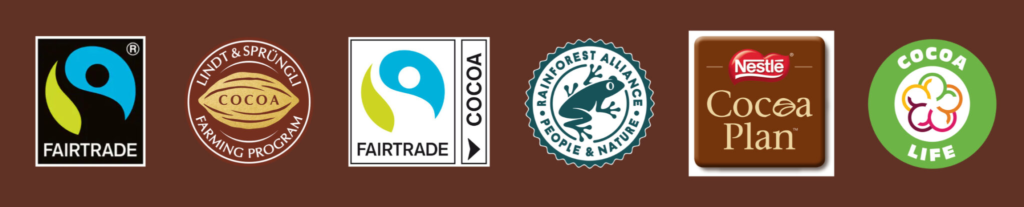
Quality labels, QR codes, frogs, flowers, golden cocoa pods: if you turn over a bar of chocolate today, you’ll discover a whole little universe dedicated to sustainability. Never before have there been so many labels and logos – and yet, at the same time, never before have there been so many unresolved problems in the cocoa sector: child labour, poverty, deforestation. How does this all fit together? And what do these labels really mean – for producers, for companies and for us as consumers?
“Could you say a few words about the reliability of the labels?” This question comes up almost every time – most recently at the Bean-to-Bar trade fair in Chemnitz. My off-the-cuff reply: “It’s better than nothing.” And yet it strikes me as too simplistic. Because the honest answer is more complicated – and more worrying. The labels have made a difference. But they don’t solve the real problems in the cocoa sector. That’s precisely why it’s worth taking a closer look.
Between guidance and an overload of choice
To be honest, the sustainability information on chocolate packaging is sometimes reminiscent of Times Square at night: everything is flashing, everything is vying for attention – and in the end, all that remains is confusion. Every label has its own logic, its own criteria and its own promises. Even industry experts quickly lose track of it all.
What do the most common labels really mean?
Overall, the well-known sustainability labels guarantee that the cocoa is produced in accordance with slightly higher environmental and social standards and that cocoa-farming families receive targeted support – without, however, fundamentally resolving structural problems such as poverty or the lack of a living wage. The Rainforest Alliance label – the green frog – focuses more on environmentally friendly farming, whilst Fairtrade Max Havelaar places greater emphasis on more stable cocoa prices, social standards and a living wage.
If you’re wondering what became of Utz – which was used by Migros for many years – Utz and the Rainforest Alliance merged a few years ago. Today, only the frog logo remains.
Incidentally, there’s a distinction within the Fairtrade label that hardly anyone is aware of: the dark Fairtrade seal means that all ingredients for which a Fairtrade label exists – such as sugar, vanilla and oranges – must be certified. The light-coloured seal, on the other hand, indicates that only the cocoa is Fairtrade-certified.
Mass Balance: The invisible system behind it
The so-called ‘mass balance’ system is a key, yet little-understood, mechanism behind many labels. The principle is this: you pay for certified cocoa, but it often does not physically end up in your chocolate. In fact, the cocoa beans are blended with beans from different regions and countries as they move through the supply chain. Whilst the additional premium paid benefits the cocoa cooperatives, the physical traceability of the cocoa beans remains an abstract concept.
Advantages
- More farming families can take part
- Scalability
- Cheaper products
Disadvantages
- Decoupling of product and origin
- Less transparency
- Loss of consumer confidence
The situation is slightly different with organic produce: here, the supply chains must remain separate, which means that, ideally, a product labelled ‘organic’ should actually be organic. Organic produce is therefore often more expensive – not only for consumers, but also for producers, who have to bear the high certification costs.
Are labels a thing of the past? A nuanced perspective
I have to admit: as far as I’m concerned, labels on chocolate packaging are a bit outdated – at least in Switzerland. But is that really the case, and does it apply to everyone? And if so, why, after all these efforts and the successful implementation? Here is my analysis in five points:
1. Raising awareness: We wouldn’t be here without the labels
Fairtrade and similar initiatives have had an enormous impact. They have shaken up consumers and businesses alike and raised fundamental awareness: there are people behind chocolate, prices are linked to human rights, and supply chains can be shaped. Without this groundwork, many of today’s debates on living wages or child labour would be almost unimaginable.
2. Mass appeal: Success – with side effects
The labels have achieved their goal: they have won over the general public – including large companies. This has expanded their reach, but has also diluted their impact. Sustainability has become scalable – but at the same time standardised and often disconnected from the actual changes taking place on the ground.
3. A turning point: Pioneers are breaking new ground
Many pioneers of fair trade, such as Claro and Gebana, have turned their backs on certification schemes. The new generation of small-scale producers, too, often chooses not to use them. The reasons: high costs, limited benefits and the close ties to large corporations. Instead, they are focusing on direct trade – which fosters closer relationships and often has a greater impact.
4. The cost of the system: responsibility is outsourced
The standards set by these labels are used by large companies, but responsibility is often passed down the chain: to the cooperatives, the producers and the governments. It is they who bear the costs and risks. Meanwhile, the brands advertise their products as ‘sustainable chocolate’. The fundamental problem remains: labels are no substitute for fair purchasing practices or prices that guarantee a living wage.
5. A tool, but not a structural solution
Labels provide an important toolkit for businesses: they set standards, offer points of reference and make it possible to highlight progress and gaps. Organisations such as Fairtrade and the Rainforest Alliance are indispensable for international policy work and for supporting businesses. However, the voluntary nature of the standards limits their scope for action or restricts it to marketing. They cannot solve structural problems – neither poverty, nor child labour, nor deforestation.
Their value depends entirely on how seriously companies implement them.
We’ll come back to what follows from this – and what needs to change – later.
What does the research say?
A study published in early 2026 (Romano et al., Discover Sustainability) examined the impact of the major sustainability labels on the living conditions of cocoa farmers. Conclusion: Rainforest Alliance: slight increases in cocoa yields, income and farming practices – but little clarity regarding deforestation, biodiversity, child labour and food security. Fairtrade: Better outcomes in terms of income, spending on education and the strength of cooperatives – but limited progress on food security, child labour and gender equality. Organic: Significant environmental benefits (fewer chemicals, healthier soils, greater biodiversity) – but often lower yields and reduced profitability. The premiums rarely make up for this. Conclusion of the study: Mainstream labels enable gradual economic improvements. The organic label performs best environmentally, but remains economically challenging. No label fully closes the income gaps.
When companies design their own logos
As well as the well-known labels, many packages feature other logos – less easily identifiable, but ubiquitous and also entirely voluntary:
- Lindt Farming Programme: golden cocoa pod, dark red circle
- Nestlé Cocoa Plan: brown logo featuring a cocoa pod, red Nestlé logo
- Cocoa Life (Mondelez, for Toblerone, Milka, Suchard, Daim, etc.): a green circle with a flower
These logos represent the companies’ own sustainability programmes. The companies implement these themselves – working with ‘their’ producers in ‘their’ supply chain. The objectives are clear: higher yields, fewer pests, access to education, combating child labour and securing access to cocoa.
The problem is that, unlike independent labels, there is a lack of uniform standards, comparability and strict controls. Transparent reports are rare, and sanctions are virtually non-existent. Above all, the programmes rarely operate with binding cocoa prices that ensure a living wage.
This is exactly what we are seeing today. In Côte d’Ivoire and Ghana in particular – the two largest cocoa-producing countries – the signs of a storm on the horizon are impossible to miss. Living conditions for cocoa farmers have not been this poor for a long time. A key reason for this is the drastic fall in prices. None of the major programmes – neither Cocoa Life, nor the Lindt Farming Programme, nor the Nestlé Cocoa Plan – has been able to cushion the impact of this slump. Because none of them were structurally equipped to deal with this collapse.
An initial assessment
The problem lies not primarily in the principles of fair trade, but in the balance of power in the market. Higher prices regularly meet with resistance from large corporations, even when producer countries such as Ghana or the Ivory Coast seek to enforce them.
At the same time, as consumers, we expect cheap, standardised chocolate. To achieve this, companies blend cocoa from different sources and set up their own sustainability programmes to ensure this flexibility.
As a result, a multi-billion system has developed around the companies’ own labels. Meanwhile, the independent Fairtrade system adheres to common minimum standards – and is, for that very reason, coming under pressure from those who need to make the most changes.
What is needed now
Beyond all these labels, programmes and promises, one troubling question remains: what is really needed? In my view, the answers are as follows:
1. A living wage – the key lever
Chocolate companies, traders and retailers must pay cocoa-farming families a price that guarantees a living income – regardless of current market prices.
This includes:
- Prices that actually allow you to make ends meet
- Purchasing practices that guarantee these prices
- The willingness to bear the additional costs throughout the entire value chain
What is a living income?
A living wage is the income a family needs to lead a dignified life; in other words, it is sufficient to cover food, access to clean water, housing, education, healthcare and a reserve for emergencies. It can be measured and calculated at regional level – and it is the responsibility of businesses to structure their procurement practices in such a way as to enable this income. These include: – Prices that are actually enough to live on; – Sourcing practices that guarantee these prices; – A willingness to bear the additional costs throughout the entire value chain. In the cocoa sector, this means that farmers must be able to make a living from their work – without having to resort to child labour or destroy their livelihoods. Important: A living wage is not a bonus. It is a human right.
2. Binding laws – and their implementation
Without clear rules, sustainability remains a voluntary endeavour. And voluntary action is not enough. The EU is leading the way: clear legal requirements on human rights, the environment and transparency throughout the entire supply chain – coupled with an obligation to implement them. Switzerland must not stand on the sidelines here.
Here, too, we need:
- Binding laws that guarantee compliance with human rights and environmental standards throughout the entire supply chain
- No loopholes that allow companies to shirk their responsibilities
- Strict monitoring and enforcement – not just reporting.
3. Transparency rather than greenwashing
There needs to be transparency regarding how companies actually source their goods: at what prices, under what contractual terms, and with what risks for producers.
4. Be inspired by the new generation of chocolatiers
A growing number of small-scale producers shows that there is another way:
Direct trade, stable and high prices for good quality, visible links to the people behind the cocoa – and a product that reflects this value. Often closer to genuine sustainability than the large, anonymous systems.
5. Labels as a real lever – and not just a checklist
Labels can help to implement legal requirements. But only if they are taken seriously. Anyone who uses them merely as a checklist, without genuine cooperation with producers, will achieve no results: no reduction in child labour, no fight against poverty, no protection of forests and water resources. The impact does not come from the label itself, but from everything that happens behind the scenes.
No single label will be THE solution on its own. The solution will arise mainly from what companies and consumers are prepared to pay for this extraordinary product that is chocolate!