

The Menyapa-Lesan Cacao Project (2025-2028) is a pioneering initiative that links sustainable cacao farming with orangutan conservation in East Kalimantan, Borneo. This collaborative effort unites Good Chocolate Hub (Switzerland), BOS Schweiz (Borneo Orangutan Survival Switzerland), and CAN Indonesia (Conservation Action Network) to protect rainforest biodiversity while strengthening local livelihoods.
© CAN 2025
The goal: Cocoa that strengthens forests and communities
In the Menyapa-Lesan project, we combine orangutan conservation with sustainable cocoa farming. Together with Dayak communities, we improve cocoa quality, yields and market access. This creates long-term income opportunities for farmers while reducing the pressure to convert rainforest for palm oil production, coal mining or other sources of short-term income.
Put simply: when growing high-quality cocoa pays off, protecting the forest becomes worthwhile too. Cocoa thus becomes an economic incentive for forest conservation and a pathway towards a more secure future for the people living in this landscape.
At a glance
| Project area | Menyapa-Lesan landscape, Berau region, East Kalimantan, Indonesia |
| Project duration | 2025–2028 |
| Beneficiaries | Up to 900 farming households in the participating communities; approximately 185 endangered Bornean orangutans |
| Project partners | Good Chocolate Hub, Borneo Orangutan Survival Switzerland (BOS Switzerland) and Conservation Action Network (CAN) |
| Additional partners | Kürzi Kakao |
An integrated conservation and cocoa initiative in the Menyapa-Lesan wildlife corridor
The Menyapa-Lesan wildlife corridor covers approximately 193,000 hectares as part of a project led by CAN and BOS Switzerland, connecting important rainforest landscapes. These ecological connections allow orangutans and other wildlife to move between forest areas, find food and reproduce.
The cocoa project complements this corridor-based approach: it creates economic opportunities for Dayak communities in and around the corridor that sustain the forest as a foundation for their livelihoods rather than displacing it.
The context
The Berau region in eastern Borneo is home to one of the world’s oldest and most biodiverse rainforests – a habitat for orangutans, sun bears and countless other species.
Yet coal mines and palm oil plantations are increasingly encroaching on the forest. Habitat loss is causing dramatic declines in orangutan populations and many other species. For Indigenous Dayak communities, however, these same industries often provide jobs and income – a difficult dilemma.
We need solutions that achieve both: protecting nature and securing livelihoods. People and nature are inseparably connected. When ecosystems are destroyed, communities feel the consequences too.
Our approach: Cocoa is a forest tree
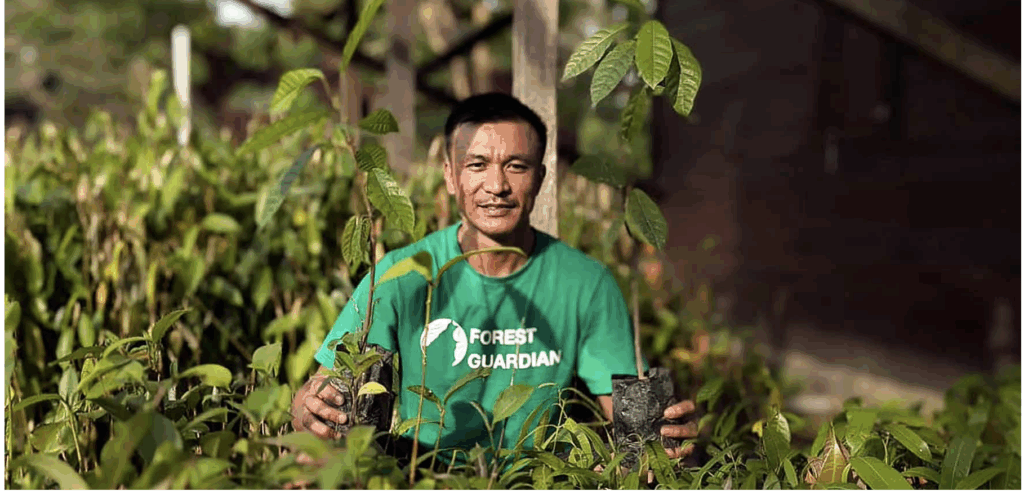
Cocoa naturally grows beneath the canopy of larger trees. In agroforestry and similar farming systems, it is therefore cultivated alongside shade trees and other crops – not as a replacement for rainforest, but as part of a diverse, productive landscape. This allows families to earn an income without clearing additional forest, while maintaining habitats and ecological connections.
The Menyapa-Lesan initiative brings together conservation and economic opportunities through a long-term, integrated and innovative approach. Our approach is designed to be resilient, adaptable to local conditions and capable of generating impact beyond the project area.
At its heart is sustainable cocoa farming as part of a forest-based system. The project brings together organisations with complementary expertise and creates four interconnected benefits:
- Local Dayak communities earn higher and more stable incomes and gain access to new markets for their cocoa.
- Orangutans, other species and the rainforest are protected when local communities take responsibility for their forests and benefit directly from their conservation.
- Together, we build a transparent and traceable supply chain. It makes visible where and under what conditions cocoa is grown, processed and traded — from the cocoa trees of eastern Borneo to chocolate in Indonesia and Switzerland.
- In Switzerland, we work with Kürzi Kakao to create chocolate with a positive impact, highlighting its origin, quality and the people behind the cocoa while raising awareness of sustainable cocoa production.
Sustainable cocoa offers a tangible alternative to environmentally harmful industries such as palm oil plantations and coal mining. The project demonstrates that economic development and environmental protection can go hand in hand – when local communities have a say in decisions, receive a fair share of the benefits and have long-term market partners.
“This project shows how cacao becomes a real reason to protect the forest. As it’s working directly with Dayak communities and the Berau government, we link better cacao quality and market access with orangutan conservation at the landscape level. Seeing livelihoods improve while forests stay standing and knowing that cocoa meets traceability, EUDR, and climate goals, shows that conservation, policy and business can truly move forward together.”
Auditya Sari, Project Coordinator, Indonesia
A holistic vision for sustainability
By integrating sustainable agriculture into a conservation framework, the Menyapa-Lesan project creates a replicable model for balancing ecological conservation and economic development.
Our goal is a system that is ecologically sound, economically viable and enables cocoa farmers to earn a living income over the long term.
This project was possible thanks to a grant from the SWISSCO Innovation Programme, which is supported by the Swiss State Secretariat for Economic Affairs SECO.